
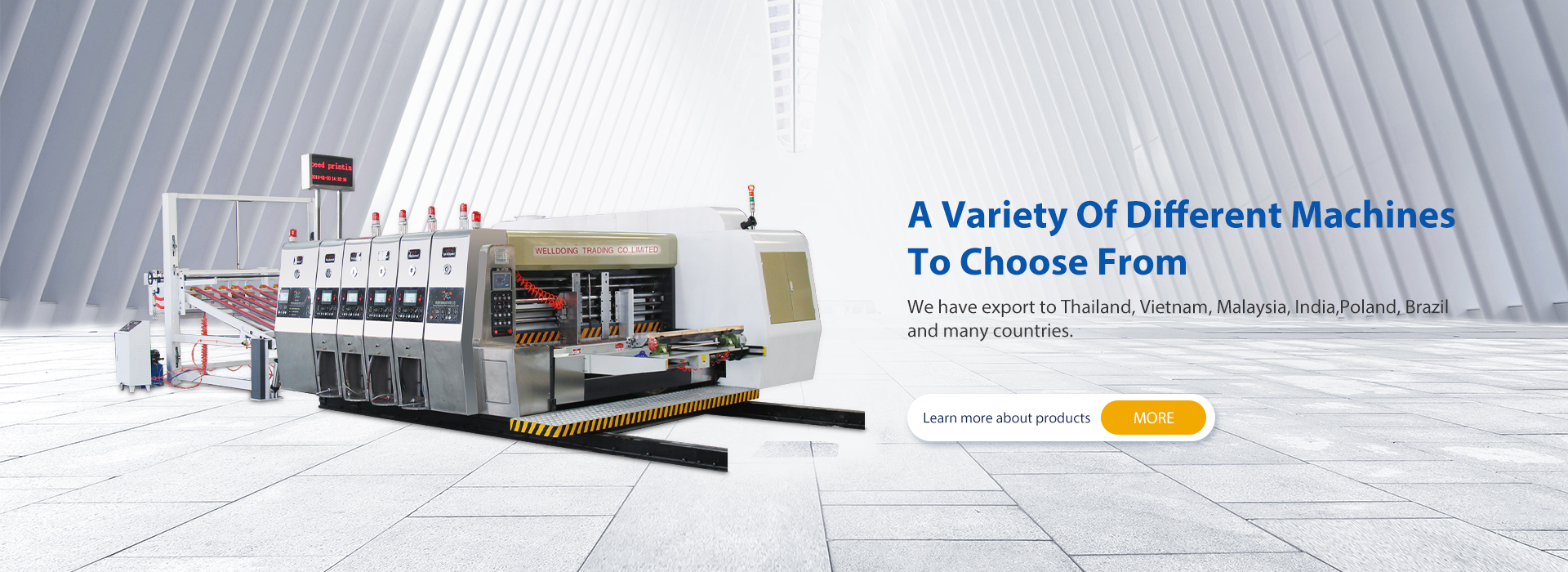
Every corrugated box plant is judged on three numbers: sheets per minute, print register, and waste percentage. The automatic lead edge feeding flexo printer slotter die cutting machine for 3/5/7 ply corrugated board is engineered to move all three in the right direction at the same time. It takes a flat blank, prints it in up to four or more colours with water-based ink, slots and creases it, rotary die cuts it, and stacks the finished box in one continuous pass — no intermediate handling, no second machine, no second setup. For plants running retail-ready packaging, e-commerce mailers and heavy-duty boxes on the same floor, that single-pass architecture decides whether you quote competitively or lose the order.
What Lead Edge Feeding Really Changes
The feeder is where most print defects are born, and it is the first place buyers should look when comparing a flexo printing die cutting slotting machine. A chain feeder drags the blank by its edge; a lead edge feeder grips the leading edge with a row of feed wheels under vacuum, so the sheet is pulled forward instead of shoved. Three practical results follow:
- Warp is tolerated, not rejected. A 7-ply board that has picked up moisture on the flutes will still feed squarely, because vacuum suction holds the sheet flat against the feed table and air volume is adjustable to suit the board’s curvature.
- Register is repeatable. Feed accuracy of roughly ±0.5 mm carries through to print, slot and die cut, which is what allows a multi-colour job to hold a hairline register at production speed rather than at demonstration speed.
- Large blanks stay possible. Skip feeding lets the machine index over a full sheet length so oversized, die-cut-heavy formats can run on a machine whose maximum printing area would otherwise be too short.
Add motorised side guides, pneumatic paper lift and a variable-frequency main drive, and changeover stops being a two-man wrestling match.
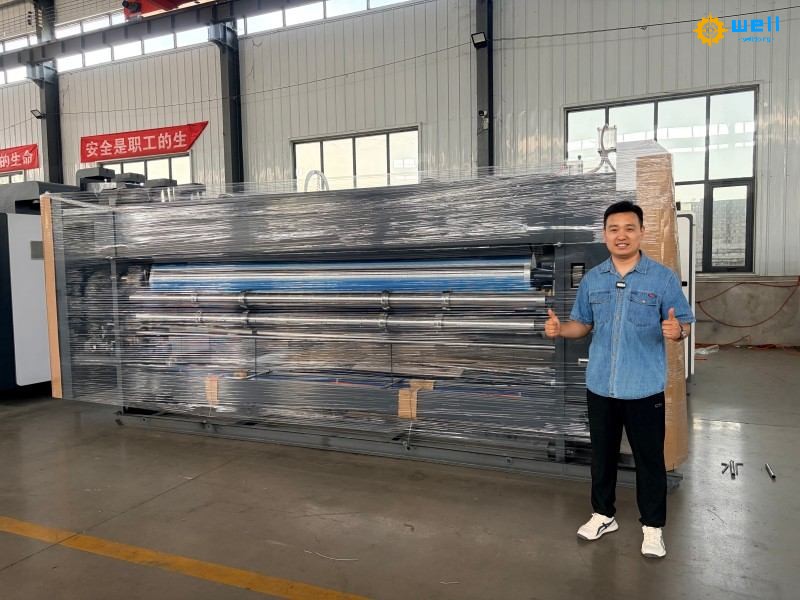
Machine Architecture: Five Stations, One Sheet Path
1. Vacuum lead edge feeder
Four rows of wear-resistant feed wheels, a dedicated suction fan, electrically positioned left and right baffles and a skip-feed function. The feeder sets the rhythm for everything downstream, so it is built with a hardened, balanced shaft and a frequency-controlled drive rather than a fixed-speed gear train.
2. Flexo printing units
Each unit carries a ceramic or steel anilox roller, a closed-chamber doctor blade system, a plate cylinder and a pressure roller with independent motorised adjustment. Ceramic anilox with a consistent cell count delivers even ink transfer and extends plate life; closed-chamber blades cut ink loss and evaporative viscosity drift. Units are configured in-line, one per colour, so a four-colour job is simply four printing stations on the same frame — and a two-colour job can be quoted on the same machine without a separate line.
3. Slotting unit
Six-axis computer-controlled slotting is now standard on machines in this class. Each knife seat is positioned motorised in the axial and circumferential directions, with the carton height set numerically from the touch screen. Scoring wheels crease the fold lines; the slotting knives cut the flaps. Typical slotting tolerance is around ±1.5 mm, which is comfortably inside the requirement for automatic folder-gluers and case packers downstream.
4. Rotary die cutting unit
A hardened die cylinder and an anvil cylinder with a ground, hard-chrome surface carry a soft rubber cover that is indexed axially in steps so wear is distributed across the full width instead of concentrated in one band. That single design decision is worth real money: the cover lasts several times longer, and the speed-difference compensation system keeps the die and the board synchronised so cut edges stay clean at high output.
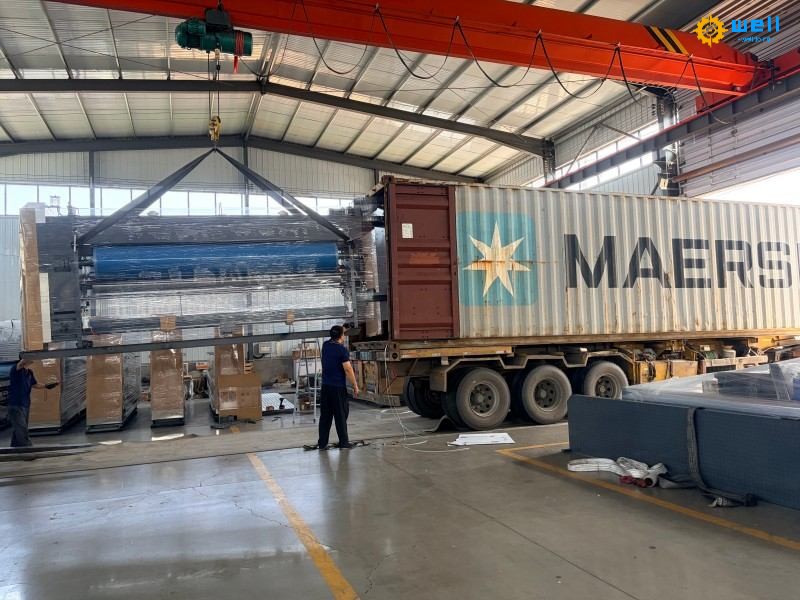
5. Counter-ejector stacker
Finished boxes leave the die cutter in a shingled stream, are counted into bundles and stacked square for palletising. Automatic counting removes the manual tally that so often becomes a customer complaint about short shipments.
Built for 3, 5 and 7 Ply — Without Compromise
Three-ply board is thin, flexible and easy to over-compress. Seven-ply board is thick, heavy and stubborn. A machine that runs one well often ruins the other. This printer slotter die cutter handles the full range by keeping every pressure point independently adjustable: printing pressure is set per unit, die cutting pressure is set at the anvil, and the slotting depth is set numerically. Board thickness from roughly 3 mm up to 12 mm is accommodated, and E-flute through triple-wall AA-flute can be scheduled back to back without a mechanical rebuild.
The practical benefit is scheduling freedom. A plant no longer needs to batch work by board grade or hold a second line for heavy duty. One flexo printer slotter die cutting machine becomes the backbone of the whole box department.
Performance Benchmarks
表格
| Parameter | Typical range in this class |
|---|---|
| Working speed | 150–250 sheets/min (model dependent) |
| Max sheet size | 1600 × 2800 mm (larger on request) |
| Max printing area | Matches max sheet minus gripper allowance |
| Board thickness | 3–12 mm |
| Printing colours | 1–8 units, in-line |
| Print register | ±0.5 mm |
| Slotting / die cutting tolerance | ±1.5 mm |
| Printing plate thickness | 3.2–7.2 mm |
| Control | PLC + colour touch screen, 200+ order memory |
Figures vary with model and configuration, so always request the tested curve for the exact size you are buying rather than the headline design speed.
Why Precision Pays
Suppose a plant runs 30,000 sheets a shift and trims waste by one percentage point. On a mid-weight five-ply box, that is hundreds of boxes recovered every shift, every day, without an extra gram of paper. Now add setup time: a machine with 200 stored orders and motorised axial positioning cuts a repeat job’s make-ready from forty minutes to under ten. Across three changeovers a shift, the machine effectively gains half a shift of productive time. The flexo printer slotter die cutting machine does not create demand — it converts existing demand into margin, and that is why the payback calculation is usually measured in months rather than years.
Automation and Order Management
Modern units ship with a colour touch screen that stores the full recipe for each job: colour sequence, register offsets, slot depth, carton height, die pressure and running speed. Operators recall the order number, confirm the board grade and press run. Remote diagnostics let an engineer inspect drive faults and production counters over a network connection, cutting breakdown response from days of travel to hours of diagnosis. Optional modules include inline inspection, barcode-triggered order recall and stacker data export to a plant MES.
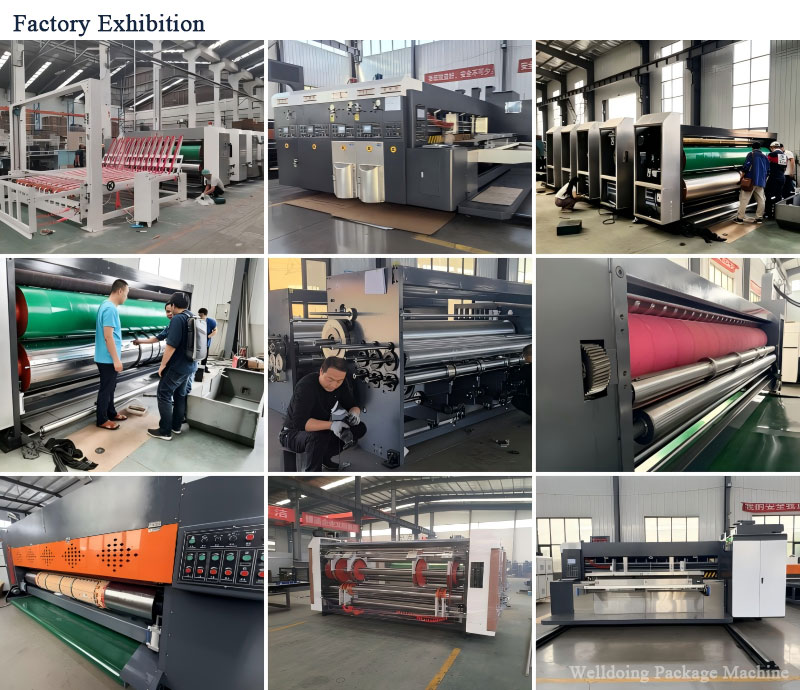
Applications
The machine serves converters producing shipping cartons, produce trays, food boxes, appliance packaging, e-commerce mailers with die-cut tear strips and point-of-sale displays. Because slotting and rotary die cutting share one frame, a standard RSC and a complex die-cut display can be scheduled in the same week on the same asset — flexibility that keeps small and medium runs profitable.
Choosing the Right Configuration
Match the machine to the biggest blank you realistically expect, not the biggest one you might one day quote. Oversizing costs capital and floor space; undersizing costs a second machine. Confirm four things before signing: the number of printing units you need today with space for a future unit, whether die cutting is rotary or combined with a flat-bed platen, the stacker format, and local spares and service. Ask for a factory acceptance test on your own board grade, with your own artwork, at the speed you intend to run.
Service, Spares and Total Cost of Ownership
Price is the smallest part of ownership. Ask for the wear-part list with lead times — anilox rollers, doctor blades, feed wheels, die covers, slotting knives — and confirm that gears are hardened and bearings come from a named supplier. A machine built on hardened gears and quality bearings holds register years later; a machine built to a price does not. CE marking, guarding, emergency stops and a documented lockout procedure should all be verified before shipment, not promised after installation.
FAQ
Can it print and die cut in a single pass? Yes. Printing, slotting, creasing, rotary die cutting and counting run in-line on one frame — the defining advantage of a printer slotter die cutter over separate machines.
Does it handle 7-ply board at full speed? Heavy grades normally run below the maximum sheet rate, but the pressure and feed systems are designed for the full 3–12 mm range, so triple-wall work is routine rather than exceptional.
How long does a colour changeover take? With stored order recipes and motorised positioning, a repeat job is back in production in about ten minutes; a new job adds plate mounting time.
Conclusion
An automatic lead edge feeding corrugated carton printing slotting die cutting machine for 3/5/7 ply corrugated board is not simply a faster printer. It is a single-pass profit centre: accurate feeding, consistent ink transfer, numerically controlled slotting, long-life rotary die cutting and automatic stacking, all on one frame and one order recipe. Specify it properly, test it on your own board, and it will set the standard every other machine in your plant is measured against.
Email:cartonmachine.tomwang@aliyun.com
Phone/Wechat/Whatsapp:+86 133 0307 8975
Post time: Nov-16-2026